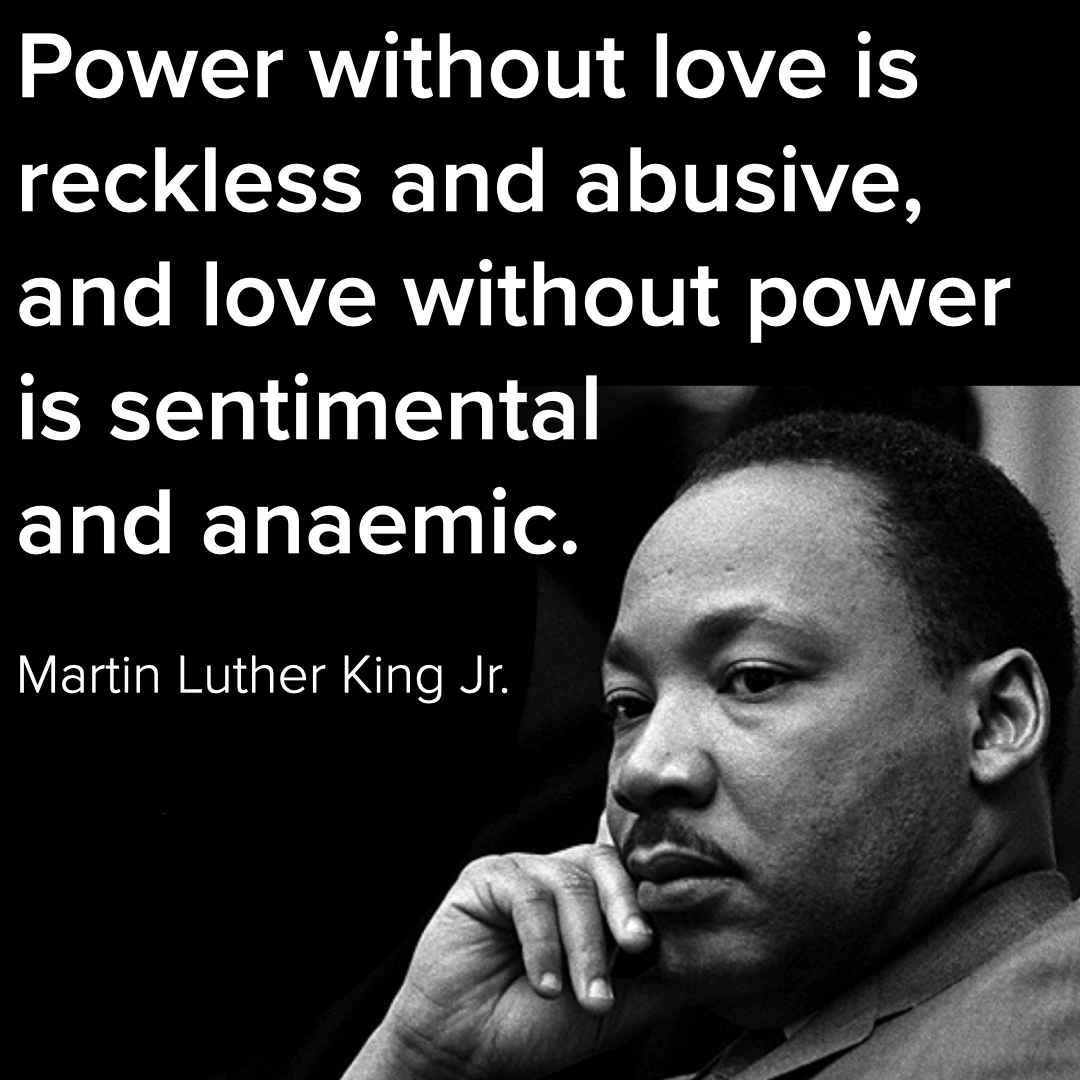
Martin Luther King Jr’s achievements were shaped by his ability to balance spirituality and practicality — could this combination help business become a force for good?
The words quoted above marked the low point during a period of crisis.
Martin Luther King Jr was struggling to make progress in the civil rights campaigns he was leading and was widely disliked.
Constant death threats on one side, and criticism on the other from those who felt he was too soft in making compromises.
This period marked a turning point where Martin Luther King Jr realised he must go further in his methods to ensure they bring results.
FILL THE STREETS AND THE JAILS
The protests and demonstrations would remain non-violent but were escalated to tactics of mass civil disobedience.
His team enlisted youths to add numbers and help fill the streets and then the jails, something he had previously resisted – but it succeeded in ramping up the pressure on authorities and bringing them to the negotiating table.
It worked, leading to a string of successes and building momentum that would ultimately lead to the Civil Rights Act.
BALANCING ACT
A key factor in Martin Luther King’s achievements was his ability to balance the spiritual and the practical.
He was reflective, philosophical and deeply caring – whilst also being strategic, analytical and results-driven.
Love was the means and the end, but Martin Luther King Jr knew that a cutting edge was needed to get there.
He added a ruthless streak, whilst remaining committed to his principle of showing love to the oppressors.
The vision in his ‘I have a dream’ speech would not have come to fruition without this delicate balance of the spiritual and the practical.
DOWN TO BUSINESS
Perhaps this is what is needed to bring about a new paradigm of responsible commerce, where business leads the way in creating positive change that can spill over into wider society.
‘Work’ is such a dominant force in our lives, and often a place that we associate with a lack of emotion, care or sentiment.
It often feels like the “power without love” as described by Martin Luther King.
But must it be this way?
There are many beacons of hope in the business world that demonstrate that a more caring, more responsible and sustainable approach has significant benefits to the company itself.
Driven by a shared sense of purpose and in an environment of trust, people in such organisations are happier, more productive, more innovative and provide better service to customers.
Customers are more loyal, less price-sensitive and make more referrals.
Suppliers and investors are more supportive, willing to go the extra mile for the pursuit of a shared mission – something that a purely transactional partner never would.
These organisations attract and retain the best people. They are happier places and more financially successful as a result.
When done right, purpose and profit are synergistic.
LOVE AND POWER
The key to achieving this lies in balancing love and power.
Profit is the fuel that enables an idea to be spread – this the ‘power’ element of the equation and our task is to combine it with a benevolent purpose.
For any company, social enterprise or even a non-profit that has a loving purpose at its core, being financially sustainable is key to building momentum and pursuing its mission.
In doing so, such organisations can help to spread the idea that love and power are not incompatible.
And to demonstrate that if love and power can be balanced, they become a potent force for good.
Too entangled in our systems to conceive of viable alternatives, we must help our children surpass us by nurturing critical thinking and creativity, confidence and care.
For all the talk of systems change – as necessary as it may be – is it something we are truly capable of?
We have known for some time that things need to change. But we have so far proven ourselves incapable of anything other than incremental adjustments – falling far short of the scale and urgency of change that is required.
We get mired in debate and disagreement, run into brick walls and get tangled up in red tape. It is as if the very systems we are trying to change are designed to prevent such change from happenening.
Perhaps these systems are so ingrained within us (and vice versa) that we cannot change them to the extent required, even if we believe we are making progress; it is like looking in the mirror and trying to blink before your reflection – you might think you’ve done it but have you really?
Perhaps we are so indoctrinated, and our ways of thinking so ossified, that we are incapable of conceiving viable alternatives.
Even if we could, it would be future generations that quickly become the guardians of these new systems.
Though we must continue to strive for incremental improvement, we should also focus on creating the right conditions for our children, to give them the best chance of surpassing us.
Rather than teaching kids how to pass exams, we should aim to equip our children with critical thinking and creativity, confidence and care. This is what’s needed to achieve systems change that is sufficient, sustainable and just.
Critical thinking and creativity – to devise completely new systems that are not shackled by the limitations of previous models.
Confidence – to believe that it is possible to replace these cornerstones of civilisation.
And above all, care – to create systems that are just.
Unrestricted by borders, language or political cycles, capitalism unites the world in its ability to spread ideas. Brands like Patagonia show how this power can be harnessed for positive impact by linking profit with purpose.
Is capitalism inherently bad?
Its core principles of profit and growth are viewed by many as an ever-escalating feedback loop, that is incompatible with a finite planet: perpetual growth results in depletion of resources, destruction of the environment and exploitation of people.
But must it be this way?
Like an algorithm, it is intrinsically neither good nor bad. The outputs are dependent upon the inputs; the results are a reflection of the human psyche.
Capitalism may be an imperfect system, but its glitches are compounded by our own flaws.
The most damaging results of capitalism are often due to profit being linked with consumption; our insatiable desire for more fuels exploitation and destruction as much as the system itself.
However, herein lies an opportunity: can profit be linked with something else – something positive?
Capitalism is nearly everywhere; it is perhaps the unifying feature of global society. This provides huge potential for positive impact.
Capitalism is the most effective means we have for spreading ideas. It is not limited to the confines of geopolitical borders. It is not restricted by language or four-year terms, nor dependent upon the changing whims of political parties and their leaders from one election to the next.
The vehicle that can travel freely throughout the realm of capitalism? A profit-making organisation.
What is carried inside the vehicle – information and ideas, the principles and purpose of an organisation – can be changed; it does not need to be another product or service just to keep the flywheel of profit and growth spinning.
In biological systems, a virus is an incredibly effective vehicle for spreading information; this is normally its own genetic material for the sole purpose of replicating itself. Gene therapy uses engineered viruses to deliver a modified package of genetic material – the vehicle is very similar and can be just as pervasive, but the information inside is designed to achieve a positive outcome.
The information contained within the profit-making vehicle of a capitalist system – how and why it makes a profit – can be anything. It doesn’t have to be Levis jeans or Coca-Cola, although those brands reached everywhere that capitalism has – not just because of the products themselves but because of what they represent – and wherever they went they also took the culture that they symbolise.
There is a growing demand for businesses to be more responsible and more sustainable, and we are already seeing the huge success of companies that have been able to respond to that.
Patagonia is a perfect example – its commitment to sustainability is just as synonymous with its brand as the quality of its products; both of these elements contribute to the generation of its profits, but what is most powerful is the extent to which the idea has spread that a sustainable product can be both higher quality and commercially successful. Not just to consumers – where it is fast becoming a norm and even an expectation – but to other companies as well.
The key lies in pairing profit with purpose: the pursuit of a social or environmental impact which is able to generate financial returns and grow.
If such an organisation – a ‘purpose company’ – can achieve profitability then not only will it be able to scale the direct impact it has but others will take notice and follow suit, leveraging market forces to scale impact indirectly and even more substantially.
Profit alongside purpose is hard to stop and impossible to ignore. Even corporate executives that are environmental skeptics will implement a sustainability initiative if the numbers stack up.
In this way, a purpose company can be like a Trojan horse. The outer appearance of a profit-making organisation is able to unlock the gates to even the most hostile territory. And then the ideology carried within that vehicle can be released.
Until there is a viable alternative to capitalism, we should focus on how the laws of the system can be manipulated for the greater good.
Altruism is a wonderful human capacity; we have all experienced the warmth of an altruistic act, or felt the deep sense of resonance from selflessly serving others.
Throughout history we have been handed down stories of people acting altruistically even in the worst of circumstances and at risk to their own safety: giving up their last penny; providing shelter to those persecuted by an advancing army. In the present day we hear of people saving the life of a stranger by running into burning buildings, donating a kidney, or tirelessly searching for survivors buried under rubble.
This is individual altruism in all its extraordinary and sporadic beauty.
Meanwhile, the Effective Altruism movement is helping to promote everyday altruism and ensure that it translates to the most impactful outcomes.
We are capable of a wide spectrum of altruism and are increasingly aware of the causes that are most in need of altruistic action – so why are we still failing to make the systemic change that is needed to address humanity’s biggest challenges?
What is needed is a coordinated, collective form of altruism – where everyone within a system, every link in the chain, is willing and able to make decisions and take action that prioritise the greater good over individual interests. But the nature of our political structures and business models mean that this is not easily achieved.
PRISONER’S DILEMMA
Real world situations are not always a binary either-or choice, such as that posed in the prisoner’s dilemma, however this model provides a useful context for considering the individual and collective dynamics of altruism and cooperation.
In this scenario there are two prisoners held in separate interrogation rooms, unable to communicate with each other. They know that they face one year in prison if they stay both silent as there is insufficient evidence to convict either of them on the most serious charge. However, they are each offered a deal to testify against the other person, allowing them to walk free whilst the other gets a three-year sentence – but if both prisoners opt for the ‘betrayal’ route, they will both serve a two year jail term.
The choice/outcome matrix is presented below:
From Wikipedia
Whilst the best outcome collectively is achieved by both staying silent, it is in each prisoner’s individual interests to betray, because this choice gives them the best outcome regardless of what the other person chooses.
Numerous research studies show that in reality cooperation (staying silent) is more prevalent a choice than logic alone would suggest, demonstrating that we are reasonable creatures rather than rational machines.
However, prisoner’s dilemma neatly illustrates the misalignment between individual rationality and collective rationality and is a helpful model for considering society at large, and particularly how decisions are made within political systems.
CHECKS AND BALANCES
The checks and balances of democratic systems ensure that power is not concentrated in the hands of one person or group. However, this also means that multiple people and groups must cooperate to reach a decision.
When a decision is more altruistic by nature – favouring minority or disadvantaged groups, people on the other side of the world, or future generations – it can be more difficult to pass through such a system.
These situations are like a prisoner’s dilemma where the optimal outcome requires each and every individual to prioritise collective interests over individual interests, but with many more decision makers than the two-player game that is prisoner’s dilemma.
Whilst it would not be unusual to flip a coin and get heads twice in a row, altruistic decisions at a systemic level rely upon a chain of decisions where the coin must come down on the right side every single time, dozens or hundreds of times over.
ROOT CAUSE
It is no wonder that many of us feel a sense of frustration or despair. The world is broken in so many ways; we know that change is needed and we have a sense of what should be done. But nothing is happening – at least not near enough. It may only take one individual within the system to prioritise their own interests over the collective and for that coin to land as tails, to break the chain and jeopardise the collective interests.
Instead of committing to change and accepting the short term setback it would bring, we continue to dither and are forced to cope with the damage that results while existential disaster looms.
The social and environmental ills of our time are all symptoms of this same underlying pathology: a lack of, or inability to achieve, collective altruism.
It also explains the brick walls we run into when grappling with issues like climate change and inequality.
Everything from humanitarian aid to reducing emissions – as important as they are – can be viewed as treating the symptoms rather than curing and preventing the underlying common cause.
CRISIS AND THE COLLECTIVE
What is missing is an appreciation that individual and collective interests are intertwined. This is true at all levels: from a family unit to a geopolitical scale, where a country represents the individual.
Acting in the collective interests may not be optimal for individual interests in the short term, but at some point in the future, individual and collective interests converge; acting in the collective interest will therefore benefit the individual in the long term. Conversely, acting in the individual interest will be to the detriment of the collective, which in the long term will ultimately be to the detriment of the individual.
We are part of an interconnected system, so regardless of how remote the constituents of the collective group may be viewed by an individual, their actions and fates are bound together.
This can be seen clearly in times of crisis, which often escalate due to short-sighted and self-serving decisions.
Whilst it can be expected that people are more prone to prioritise self-interest in times of crisis, it is at these moments that collective action is needed most.
One of humanity’s most recent crises offers a perfect example of the fallacy of individual interests on a geopolitical scale and how they are inseparable from collective interests.
It may – hopefully – serve as a lesson for how collective altruism can help avert our most imminent crisis.
CORONAVIRUS AND THE CLIMATE CRISIS
During the pandemic, some countries stock-piled huge volumes of vaccines – far more than what was needed to vaccinate their population. Other countries did not have enough, and these places therefore had a higher probability of vaccine-resistant variants emerging. Those that did (i.e. Omicron) were more contagious and moderately resistant to vaccines, but thankfully less virulent.
If a more deadly vaccine-resistant strain emerged it would have rendered the vaccine stockpiling pointless and plunged the world back into lockdowns because of short-sighted and seemingly self-serving decisions.
Recognising that decisions are really taken within a global system, adopting a model of collective altruism may have temporarily set-back the agendas of some individual countries, but it would have led to a better outcome on a global level.
Like a virus, the environment also cannot be confined by the lines drawn on a map.
The climate crisis is perhaps the most obvious – and certainly the most urgent – call to action for us to make decisions as a truly interconnected and interdependent global community.
Many countries have set ambitious 2030 goals and publish figures that indicate progress towards sustainability, without committing to the scale of action required. Some are effectively outsourcing their emissions to other nations.
A smaller number of countries are genuinely taking actions that make a difference. Very few are doing this beyond their own borders.
Although we can be glad that climate action is on the international agenda, the responses of most countries are myopic and nationalistic – they must go further than just keeping one’s own house in order, or creating that appearance.
What matters is making the necessary change on a global level; if we continue to damage the environment and tipping points are reached, we will all suffer. We are all tied into the same outcome. We already have sufficient and shocking evidence that collective interests are intertwined, that the devastating results of climate change are not handed out to each country in proportion to their emissions.
We therefore need to be responsible for our actions at both an individual and collective level. Rather than pressuring and criticising other countries, we need to help and support each other.
PROSPERITY AND COLLECTIVE ALTRUISM
These examples demonstrate the importance of more economically developed countries helping lesser developed ones.
Whilst individual altruism is independent of one’s material wealth, it can be assumed that there is a threshold for prosperity above which a population must be to achieve collective altruism, and understandably so – for those living in poverty, war or oppression, their focus is naturally on their own safety, food and shelter.
If a more economically developed country (‘country M’) achieves collective altruism for the benefit of a less economically developed country (‘country L’), prosperity will rise in country L. And if we accept that all interests are intertwined in a global system, the prosperity of country M will also increase in the long term.
Once country L reaches a certain level of prosperity, it too enacts collective altruism.
We therefore reach a virtuous cycle where collective altruism increases prosperity and prosperity increases collective altruism.
The spark that sets this flywheel in motion is country M acting in a collectively altruistic way. It must be capable of sacrificing an amount of additional prosperity at home in favour of significantly improving the prosperity of those elsewhere, with the belief that it will be both individually and collectively beneficial in the long term.
Achieving this at a systemic level is a tall order – it requires most or all people to be good and to make good decisions most or all of the time. What can be done to improve the chances of this happening?
HOW TO NURTURE COLLECTIVE ALTRUISM
For centuries, philosophers have debated the source of human morality. Are people inherently good, but corrupted by society? Could it be the other way around – do we have an innate evil streak that is civilised by the systems around us? Or are we born with a clean slate and learn a set of morals, shaped by our environment?
All sides of this argument acknowledge that nurture is key; that even if we are born with a certain disposition, it is altered by our environment.
How can we reshape society so that collective altruism is fostered, rather than frustrated?
We suddenly find ourselves in a world that is very different to the one in which many of our foundational systems and structures developed. This systemic infrastructure – how governments are elected, how we do business, how we educate our children – has come under criticism for not incentivising or teaching the right behaviours, for being incongruent with the present day realities and challenges of a global society – an interconnected world of infinite possibility but finite planetary limits.
Should we try to repair this infrastructure, or tear it down and build something new in its place? Reform or revolution – the central question of systems change.
Perhaps these systems are so ingrained within us (and vice versa) that we cannot change them to the extent required, or conceive viable alternatives. Even if we could, it would be future generations that quickly become the guardians of these new systems.
One of our key areas of focus must therefore be education: to equip our children with critical thinking and creativity, confidence and care – to devise completely new systems that are not shackled by the limitations of previous models; to believe that it is possible to replace these cornerstones of civilisation; and above all, to create systems that are just.
Education begins long before a child’s first day at school. Unfortunately, early childhood education is something that much of the world struggles with – including (and especially) western nations. A lack of public funding means that childcare fees are too expensive for most parents; but care ratios mean that technology and efficiencies can only go so far. Even with nursery bills that eclipse mortgage and rent payments, there is not enough income to pay staff a living wage. The numbers simply do not stack up. Compounded by stringent regulation and the resulting administrative burden, staff are overworked and underpaid – not to mention often undervalued – and hence there are severe shortages of childcare spaces.
Finding a way to repair this industry is as important as ensuring that collective altruism is one of the behaviours it is able to nurture.
Beyond the early years and into schools, educational reform is already well underway, with a recognition that training kids to pass exams is not the best approach to developing the behaviours and skills they need to thrive in the world, and to help the world thrive. The task is immense and extends even into the most unexpected and benign of areas, such as recreation.
Kids mostly play finite, zero sum games, teaching them from a young age that one party wins at the expense of the other. These behavioural patterns influence adult life and spill over from ‘finite’ games such as sports (defined as having known players, fixed rules, and an agreed-upon objective), into ‘infinite’ games such as business (known and unknown players, changeable rules, and where the objective is to perpetuate the game – not to win).
The language used by many business leaders (‘beat the competition’, ‘be number one’) shows a lack of understanding of what kind of game they are playing. “There is no such thing as winning business – it doesn’t exist”, Simon Sinek explains – and this common flaw in our wiring ultimately leads to disastrous consequences.
Many aspects of life – and especially the important ones – are not finite or zero sum games. Yet we are effectively teaching our kids that progress and success require us to ‘win’ at someone else’s expense.
What if we are taught that cooperation is the surest way to the optimal outcome? And that we must strive to balance individual and collective interests?
What if our children learn to expect that others will also act in cooperative way?
In the example of prisoner’s dilemma, it becomes much easier to choose the cooperative course of action if it is expected that the other person will be doing the same.
THE BOUNDARIES OF ‘COLLECTIVE’
Finally, we should consider how far we can push the boundaries of to whom – and what – the collective extends.
The first layer is the ‘collective us’ – this includes the self and those most proximate and familiar: me and my group. The wellbeing of the ‘collective us’ is more immediate, more tangible – and so it is easier to appreciate the connection of individual interests with those of the collective us.
Beyond that is the ‘collective other’. There is a higher barrier to overcome here due to distance and unfamiliarity – whether active (xenophobia) or passive (‘out of sight, out of mind’).
The ‘collective other’ has two levels – everyone else and everything else. Considering the interests of present day citizens across the globe is just the first step; what about those of future generations? What about all living things, and the planet itself?
These are still collectives that we belong to, and although more remote or more different, our interests are still intertwined with the collective other.
Throughout human history, our horizons have continued to extend and the ‘collective us’ has gotten increasingly larger, encompassing groups previously viewed as ‘other’. Warring tribes became provincial factions, which became nations – which until the recent rise in nationalistic politics were becoming increasingly cohesive on a multi-national level (e.g. the European Union, the United Nations).
We must seek to course-correct back onto this long-standing arc of history, a slow but sure direction of travel towards togetherness; the path to collective altruism.
Have we become obsessed with ‘goals’? What if we celebrated the process rather than the results?
The Stoics teach us to focus on what is within our control. Achieving goals is usually dependent upon externalities: we can be perpetually frustrated despite our best efforts.
“So in life our first job is this, to divide and distinguish things into two categories: externals I cannot control, but the choices I make with regard to them I do control.”
– Epictetus, Discourses – Book II, 5
Even realising one’s ultimate goal often results in a feeling of emptiness after the initial euphoria has subsided.
How do Olympians feel after finally winning gold? How do mountaineers feel after finally conquering Everest? What is left after that?
“As it is not one swallow or a fine day that makes a spring, so it is not one day or a short time that makes a man blessed and happy.”
– Aristotle
Most of us may never reach such heights. Should we aim for the stars anyway, or set our sights on more realistic goals?
Maybe it is neither, and we should only hold ourselves accountable for our progress towards something meaningful.
Making a small step forward each day is entirely within our control. And the small steps add up.
Do not waste time gazing up at the mountain, frozen by its enormity and the seemingly unreachable distance to the summit.
Instead focus on the path in front of you. One step at a time. Steady and purposeful.
While we should try as hard as we can and direct our efforts to worthy causes, we must not get too caught up in the outcomes of our efforts.
“Be calm and composed, because things in themselves don’t matter.”
– Epictetus, Discourses – Book II, 5
The only things that can be ‘good’ or ‘bad’ are those which are under your control. Outcomes therefore can be neither good nor bad as they are dependent upon externalities.
Be guided by a greater purpose, rather than a specific achievement or attainment of something. And if your best efforts are dedicated toward its pursuit every day, you can be content.
“We are what we repeatedly do. Excellence, then, is not an act, but a habit.”
On 5th May 2009, with the world still reeling from the effects of the global financial crisis, a secret gathering of billionaires took place at the elegant but discrete President’s House within the grounds of New York’s Rockefeller University. This event – a dinner arranged by Bill & Melinda Gates and hosted by David Rockefeller – marked the first stage of an ambitious plan devised by Warren Buffett.
Michael Bloomberg, George Soros and Oprah Winfrey were among those invited. Subsequent dinners were held in Manhattan, San Francisco, London, India and China.
The Giving Pledge was announced the following year, with 40 billionaires making a public commitment to give at least half of their wealth to philanthropy during their lifetimes or upon their death.
A decade later and the number of pledgers has increased to over 200, equating to an estimated $500bn in philanthropic capital.
This represents the world’s single largest non-sovereign source of capital. It dwarfs the record annual volume for VC investment in the US, which hit $131bn in 2018.
A number of similar initiatives followed, such as Pledge 1% and Founders Pledge, adding billions more in their own right.
However, the success of the Giving Pledge has been called into question.
WAKING A SLEEPING GIANT
A well-known disconnect persists between the appetite for philanthropy and the amount of money that is actually funding benevolent organisations and initiatives.
The United States, which has built upon the precedent set by the great industrialists-turned-philahtropists Andrew Carnegie and John D. Rockefeller, continues to be a world-leading philanthropic force: it contributes more than two-thirds of the signatures to the Giving Pledge.
However, analysis by the Bridgespan Group shows that the ultra-wealthy families of America are currently donating just 1.2% of their assets per annum – far below average long-term investment returns which are close to 10%.
This means that wealth continues to accumulate: far more is earned in interest, dividends and capital gains than is being donated – despite the clear desire to re-distribute capital to benevolent causes.
Many commentators attribute this disconnect to structural inadequacies in the field of philanthropy. As Kelsey Piper’s Vox article explains, “Giving away a lot of money, if you want to do it effectively, is actually not that easy… The pledge could have had more of an effect if there had been some sophisticated infrastructure for identifying promising giving opportunities that could absorb billions of dollars in funding, and transparently making the case for those giving opportunities to potential funders.”
Furthermore, the findings of a US Trust study revealed that of the high net worth individuals that do make donations every year, “only 40 percent are satisfied with their giving. In general, donors feel either that their money doesn’t have an impact, or that recipients haven’t kept them in the loop regarding milestones and research updates.”
A popular solution is for philanthropy to lean on the principles of private equity (PE). Jeffrey C. Walker, an influential figure in both worlds, outlines a number of ways in which this can be achieved, with the utilisation of more sophisticated tools and infrastructure enabling philanthropic capital to be pooled into professionally-managed funds.
A WOLF IN SHEEP’S CLOTHING?
In the space of a few decades private equity has grown into a multi-trillion dollar industry; it is an incredibly efficient machine for attracting capital, identifying and structuring investments, and generating returns.
Philanthropy needs to quickly acquire such machinery to allow it to manage large volumes of capital effectively and independently.
Philanthropy represents a rich mine in a poor country: it either needs to develop the expertise and infrastructure to retain control over its precious resources so that it can further its own agenda, or risk the foreign powers of PE tapping into its reserves to fuel its own growth. Some element of the latter is inevitable and can already be seen to be taking place.
The burgeoning field of responsible and sustainable investing, which places a greater focus on achieving a positive societal outcome alongside the generation of profit, demonstrates a blurring of the lines between philanthropy and PE: as noted in a McKinsey article, “global sustainable investment now tops $30 trillion—up 68 percent since 2014 and tenfold since 2004.”
Furthermore, the consideration of ESG (environmental, social and corporate governance) factors has quickly become part of mainstream investment appraisal criteria.
However, rather than philanthropy learning from private equity, these trends show the opposite is happening.
An increasing number of funds have learnt to differentiate their proposition to would-be investors by capitalising on rising demand for the generation of returns through more responsible means.
THE FUNDING SPECTRUM
Private equity and philanthropy have traditionally existed as two distinct categories of funding.
PE and venture capital (VC) follow a commercial model, where the focus is on profit. Funding is provided in return for shares in a company; the money is used to grow profits, increasing the value of the business and enabling the investment to be exited at a gain.
Money goes in, more money comes out.
Whereas, philanthropic capital is provided in the form of donations and grants to fund an initiative – usually implemented by a not-for-profit (NFP) organisation – that seeks to achieve positive societal/environmental outcomes.
The focus is on ‘purpose’ rather than profit. Many NFPs are dependent upon donations and grants; once the initiative is completed and the money has been spent, the process must be repeated to achieve further benefit.
Money goes in, societal/environmental benefit comes out.
As summarised by Don Shaffer, CEO of RSF Social Finance, “the dominant model remains a compartmentalized world where venture capitalists aim to make as much money as they can in the shortest possible time and philanthropists give money to donation-dependent nonprofits”.
However, Shaffer continues, “forward-looking funders are taking an approach that crosses conventional boundaries.”
A middle ground is beginning to form between these traditionally distinct categories, which can now be viewed as poles on a spectrum.
Over time, commercial investors have recognised that factoring ESG risks into their investment decisions helps to protect value, particularly in a world of increasing transparency and scrutiny.
This gave rise to a new breed of investors, ranging from those who ‘negatively screen’ for ESG risks, to those who actively work to mitigate them.
Some funds take it a step further, only investing in companies that are directly pursuing environmental and social causes, whilst accepting that the resulting financial returns may be lower than traditional investments.
Taking a closer look reveals that much of the middle ground consists of PE funds that have shifted to the left, employing the same underlying commercial investment model whilst incorporating varying degrees of conscience.
The ESG boom and the rapidly populous cohort of left-leaning PE funds is the result of the capitalist machine responding to changing demands, which in this case is a growing desire to do better for the planet and society.
Assuming that the capital flooding into this middle ground has flowed from the right side of the spectrum, it is a positive sign that the world of finance is taking a step towards a more responsible future.
But it does not directly address the challenge of mobilising the vast sums of philanthropic capital that will continue to lie dormant or be lured away to the right hand side of the spectrum.
So how can Philanthropy take its own step into the new middle ground and unlock the huge potential of the funds at its disposal?
Capitalism has become more responsible; can philanthropy become more financially impactful?
A STEP TO THE RIGHT
The groundwork has already been laid. Over the last decade, new legislation has paved the way to unlocking philanthropic capital and magnifying its effectiveness.
This followed a gradual realisation that the solutions to the world’s most pressing issues may not lie solely within the public sector and NFPs – but that the dynamism and entrepreneurial spirit of the private sector can also play an important role.
A key development was the creation of a new form of legal entity in the US – the Low-profit Limited Liability Company (L3C). This hybrid structure can be adopted by mission-driven enterprises that have, in the words of Marc J. Lane, a leading figure in this arena, “modest financial prospects, but the possibility of major social impact.”
The L3C form is specifically designed to leverage program-related investments (PRIs) from charitable foundations. These are akin to the commercial funding model in that they can generate financial returns, but that must not be the over-riding goal. If a purely profit-driven commercial funder would make the same investment on the same terms, it is unlikely to qualify as a PRI.
PRIs are an important mechanism for deploying philanthropic capital into the private sector. A foundation must distribute 5% of its assets every year in order to maintain its tax-exempt status. The majority of this distribution is in the traditional form of philanthropy outlined above: donations and grants. But PRIs can also be counted towards the 5%, provided that the primary objective of the investment (and its recipient) is to further the underlying purpose of the foundation, and that the generation of profit is not a significant goal.
The Gates Foundation – an extremely influential force in the new age of philanthropy – launched a dedicated PRI fund in 2009, now called the Strategic Investment Fund. However, foundations have largely shied away from PRIs due to the grey area left between purpose and profit and the risk that an IRS audit would subsequently view an investment as insufficiently purpose-driven and overrule the eligibility of the PRI – with the potential to cause significant tax complications for the foundation.
L3Cs avoid this ambiguity. In an interview with Forbes, Lane explains that “by statute, the L3C is obligated to be mission-driven and that mission is superior to profits.”
Several US states have passed legislation to authorise L3Cs, providing clarity and assurance to foundations that funding such companies will be classed as a PRI. Whilst the L3C is the most direct link, additional forms of legal entity (such as Benefit Corporations) have proliferated, helping to channel philanthropic capital into worthy private sector recipients.
Companies that pursue a benevolent purpose and have the potential to generate profit alongside a positive environmental or social impact (herein referred to as a ‘purpose company’) can be an extremely effective means for unlocking the potential of philanthropy.
LINEAR VS CIRCULAR PHILANTHROPY
A big advantage of using philanthropic capital to fund a purpose company is that the capital can be recycled.
Instead of the linear ‘money in, benefit out’ model of traditional grants and donations, a purpose-driven company can generate profit alongside social/environmental impact.
Linking purpose with profit is an incredibly efficient way of propagating benevolent causes. Not only does the purpose company re-invest its profits to generate an ever increasing impact, but it also shows the market that such activities can be profitable, and other private sector companies will follow suit.
Furthermore, philanthropic investments into purpose companies have the potential to be exited at a gain in the future, allowing the capital to be returned to the fund or foundation and redeployed.
PRIs can therefore unlock a huge amount of impact per unit of philanthropic capital.
As explained by British philanthropist Sir Harvey McGrath, who allocated an initial £1.5m into a Donor Advised Fund (a vehicle from which such philanthropic investments can be made): “the funds have been recycled many times, so that my initial investment has enabled a total commitment of £6.6m in more than 400 deals.”
“Philanthropy’s shift to seeking both social good and financial return could be our best bet when it comes to filling the social-innovation funding gap”, states Christian Braemer, CEO of Benefunder, in a Stanford Social Innovation Review article.
Such investments are not only able to plug this funding gap, known as the ‘valley of death’ – when early stage companies do not yet have the commercial traction to secure traditional sources of funding, but require capital to reach that point – but they also have the added benefit of attracting subsequent VC or PE investment.
INVESTING VS GIVING
The valley of death must be navigated by all innovative businesses in their nascency, but for those with the noble objective of shaping a company around a benevolent purpose there is the added challenge of balancing that purpose with financial viability.
A relentless pursuit of profit too early may undermine the purity and effectiveness of a societal or environmental purpose.
People, planet and profit do not need to be prioritised over one another; sustainable and socially beneficial business models can also be better for the bottom line. But obtaining that equilibrium is a precarious balancing act during the infancy of a company.
To safeguard the benevolence of a purpose company, it may be best to remove financial metrics from the equation – at least initially – and for philanthropy to build out from its heartland of grants and donations.
There is a fundamental difference between investing and giving. Perhaps some philanthropic investments risk straying too far to the right hand side of the funding spectrum – and have leapfrogged the opportunity gap identified on the diagram above. A more natural first step to the right would be to retain the traditional mechanics of philanthropy and provide funding to early stage purpose companies in the form of grants.
Not being treated as a traditional equity investment provides more room for the purpose company to focus on delivering impact. Indeed, a criticism of L3Cs is the conflict that can arise between different stakeholders once traditional commerical funders become involved, and how to balance purpose with fiduciary duties.
THE ELEPHANT IN THE ROOM
As soon as financial returns are brought into play, priorities can swiftly change. The ideal scenario would be for a purpose company to raise sufficient grant funding to see it through its formative stages – to the point at which it has developed an organisational structure, system of governance and a culture focussed on delivering its purpose effectively, whilst having demonstrated an ability to monetise it.
This would be the foundation upon which to foster the commercial performance of the company.
The elephant in the room is the scenario where the purpose company does become profitable as a result of its benevolent trading activity, which is of course the desired outcome. Should the philanthropic entity that provided early stage grant funding be entitled to some form of return?
The potential for a financial upside should not be excluded, but must be considered and structured carefully.
A number of mechanisms for achieving this have already been conceived and implemented.
Referring to the fallacy that “business models either return at -100%, and thus require donations or subsidies, or return well above inflation rate, and thus attract loans or equity”, the authors state that, despite the vast majority of capital channeled to the two ends of the spectrum, “the most interesting ideas live between these extremes, and clash with the expectations of traditional donors and investors alike.”
The authors recommend that philanthropists “deploy a broad range of financial instruments covering the full spectrum of financial returns from -100% all the way up to positive returns.”
CONVERTIBLE GRANTS
The most interesting and potentially impactful of these instruments is the convertible grant.
Here, the purpose company receives early stage philanthropic funding in the form of a traditional grant, thus avoiding undue pressure on financial metrics during its infancy – but with the potential for the grant to subsequently be converted into equity, thus enabling the philanthropic fund to realise a return and recycle the capital.
The success of convertible grants will hinge upon carefully defined triggers for conversion, and how the relationship with the company is managed once the donor transitions to an investor.
Conversion triggers will of course need to be specific to each case, but in general they would be best linked to external events rather than performance metrics of the company itself. This helps avoid a conflict of interest and undue pressure to hit arbitrary targets.
Such events could include a subsequent VC/PE investment, or a sale/change of control – both of which demonstrate the comercial success of the company through an external point of validation.
The mechanics of conversion could be similar to those of VC convertible loan notes, with the discount (and/or valuation cap) increasing in line with metrics that indicate the commercial progression of the business, or the nature of transaction (from minority stake investments through to buy-outs and IPOs).
There could also be a backstop date for conversion, after a sufficient period of time for the commercial viability of the purpose company to have been determined: if the company is still operating after five years for example, it is likely that it is a commercial success.
If financial targets are set, they should be on a sliding scale basis rather than all-or-nothing, to avoid the risk of dysfunctional behaviour concerning the achievement of arbitrary metrics.
GREAT MINDS, FOR THE GREATER GOOD
Whilst conversion mechanics are objectively complex, it is the intangible dynamics of relationship management between the philanthropic entity and the purpose company that will likely be the most challenging to get right.
Conversion from grant to equity should mark the handover to a different support team, from one with a charitable/purpose focus to one with a commercial/profit focus. A different type of professional will be best suited to one or other of these stages of the relationship.
Philanthropic funds of the future will likely split their portfolio teams, with a handover to investment professionals once shares are obtained; by this time the culture and governance of the business has been established, and the benevolent trading activity has demonstrated commercial viability. More steer from a financial perspective would at this point not only benefit the company, but also the fund (increasing the likelihood and quantum of a return that can then be recycled) and the underlying philanthropic cause (by demonstrating to the market that such activities can be financially lucrative).
However, there should still be a level of continuity and the purpose element of the equation must not be neglected – some oversight from the charitable arm should remain.
Whilst the focus throughout this piece has been on the perspective of the philanthropist, it is worth considering that of those who will be the founders of purpose companies. In doing so, the argument for convertible grants becomes even stronger.
The availability of non-dilutive funding capable of bridging the valley of death is an extremely attractive proposition to a would-be founder of a purpose company. Not only can they avoid ceding control of their business, but they will have a greater share of the upside – the grant only converts to equity when commercial success is proven, and it coverts to a lower amount of equity than a traditional investor would demand (in order to be classed as a PRI).
Whilst purpose companies may not have as lofty valuation prospects as a purely profit-driven enterprise, the availability of early stage funding that allows the founder to keep control and a larger share of future exit proceeds should help to attract and incentivise more scientists, engineers and entrepreneurs.
Convertible grants can therefore unlock the full potential of human capital and philanthropic capital – ensuring that the world’s best minds are working on solutions to the world’s greatest challenges.
Lessons from the grandfathers of Stoicism and the 80/20 principle on effective communication, impactful decks and engaging presentation.
Listening is more than simply not being the one talking – it requires concentration: resist the distraction of another device or something else popping up on your screen; avoid being lost in your own thoughts or preparing what you will say in response; be present and focussed.
What if we took Zeno’s proverb a step further and applied the Pareto principle? If 80% of the effects comes from 20% of the causes, then should we have four ears and one mouth?
It seems reasonable that 80% of intended meaning can be conveyed by 20% of the communication.
Or in other words, once the most informative 20% of words on a given matter has been spoken, continuing to talk represents diminishing returns: the more someone drones on, the less attention is paid to what they are saying.
Consider a presentation where the most important slide bears the key message that the presenter wishes to press upon the audience.
In pitch A, the slide has ten bullets points explaining the key message.
In pitch B, the slide has two bullets points explaining the key message.
In which presentation will the greatest amount of attention be paid to each point?
However, not all meaning in communication is conveyed by words alone. In fact, only a very small percentage.
Albert Mehrabian, a pioneering researcher of body language in the 1950’s, found that the total impact of a message is about 7 percent verbal (words only) and 38 percent vocal (including tone of voice, inflection, and other sounds) and 55 percent nonverbal (i.e. body language). (2)
So perhaps Zeno should have also paid reference to the eyes: if 55% of information is visual (body language) and 45% aural (the words spoken and how they are spoken) then nature has, more-or-less, given us the correct proportions of eyes and ears.
(The fact we do not have 11 eyes and 9 ears is a sure victory for aesthetics over mathematics)
People may have two eyes and two ears, however they only have one trail of thought.
An increasing volume of research demonstrates the fallacy of multitasking: not only is it significantly less productive than doing one thing at a time, but it has been shown to lower iQ and potentially cause lasting physical impairment to the brain. (3)
Returning to our presentation scenario, this gives further reason to avoid the approach of pitch A: not only is the audience’s attention being diluted across ten points, but there is a greater chance that they will be trying to read and listen to the presenter simultaneously – and be destined to miss nuance or misinterpret the message.
In summary:
Take the time to listen – really listen. Be present and focussed.
Use your air time wisely: boil down your key points; identify and hone the critical message; communicate it with precision and brevity.
Ensure your intonation and body language are consistent with the message and maximise its impact.
When presenting a deck, minimise the number of words on screen if you want the audience to listen to what you are saying.
“I have made this [letter] longer than usual because I have not had time to make it shorter.”












 Towards Better